What Canada's Strong May Jobs Report Really Means for Borrowers
For much of 2026, recession concerns have dominated economic headlines.
Questions about slowing growth, consumer spending, and housing affordability have led many Canadians to wonder whether they should delay major financial decisions—including purchasing a home.
But sometimes the data tells a different story.
According to Statistics Canada's Labour Force Survey, the Canadian economy added approximately 87,800 jobs in May 2026, significantly exceeding market expectations. At the same time, the unemployment rate declined from 6.9% to 6.6%.
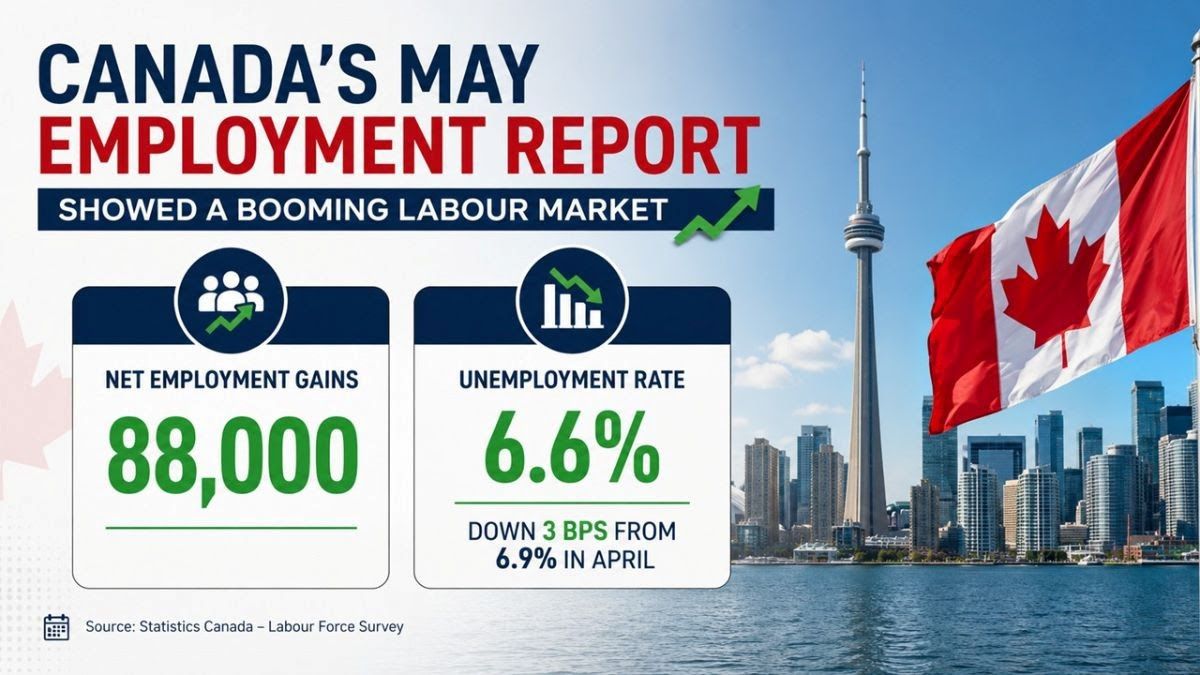
Photo: Canada's May Employment Report - Statistics Canada - Labour Force Survey
More importantly, much of the growth came from full-time employment, with gains concentrated in sectors such as construction, transportation, and accommodation and food services.
Why Mortgage Lenders Pay Attention to Employment Data
When economic reports are released, many borrowers immediately focus on one question:
"Will this affect interest rates?"
While rate expectations matter, lenders often look beyond headline numbers.
From an underwriting perspective, employment data provides insight into the overall stability of household income and business activity across the economy.
A stronger labour market generally signals:
-
Greater income stability for borrowers
-
Reduced risk of widespread payment defaults
-
Continued business activity across key industries
-
Improved confidence among consumers and employers
That doesn't mean every borrower will automatically qualify more easily.
However, it does provide valuable context when lenders evaluate risk.
The Difference Between Market Headlines and Individual Qualification
One of the most common misconceptions among borrowers is that mortgage approval is determined primarily by the direction of the economy.
In reality, qualification is far more personal.
Two individuals can apply for a mortgage during the exact same economic environment and receive very different outcomes.
Why?
Because lenders are evaluating questions such as:
-
Is the borrower's income stable and verifiable?
-
Does the industry they work in demonstrate resilience?
-
Can business cash flow support long-term mortgage obligations?
-
Is the overall financial picture consistent with the requested loan?
For self-employed borrowers, these questions become even more important.
A business owner may have strong cash flow but report lower taxable income due to legitimate tax planning strategies. Another borrower may show healthy revenue but have documentation that does not align with lender requirements.
The challenge is rarely just income.
The challenge is demonstrating the complete financial story.
Structure Matters More Than Predictions
Many people spend significant time trying to predict where the economy, housing market, or interest rates will move next.
While those discussions are important, they often distract from the factor borrowers can actually control: the quality of their mortgage file.
At The P Capital, we often see situations where the difference between approval and rejection is not the borrower's financial position itself, but how that position is presented, documented, and structured.
This is particularly true for:
- Self-employed professionals
-
Incorporated business owners
-
Commission-based earners
-
Real estate investors
-
Borrowers with multiple income sources
Mortgage financing is not simply about submitting documents.
It is about understanding how lenders assess risk and structuring a file accordingly.
That's why our approach focuses on precision underwriting—analyzing income sources, financial statements, business performance, and lender fit before a file is submitted.
Because in uncertain markets, preparation often matters more than prediction.
Final Thoughts
Canada's May employment report serves as a reminder that economic narratives can change quickly.
While headlines may focus on recession concerns, lenders continue to assess borrowers based on fundamentals: income stability, documentation quality, cash flow, and overall financial strength.
For borrowers—especially those who are self-employed—the most productive question may not be "What will happen next?"
It may be:
"How well prepared is my mortgage file today?"
At The P Capital, we don't simply submit mortgage applications.
We structure them.
Rooted. Refined.
The P Capital is a boutique mortgage advisory practice operating under Mortgage Connection and within the Dominion Lending Centres network.
Sources:
- Statistics Canada. Labour Force Survey, May 2026.
- Dominion Lending Centres. Economic Insights: "So Much for Recession? Canada's May Jobs Report Was a Blockbuster."
Disclaimer: The information provided is for educational purposes only and should not be considered financial or mortgage advice. Mortgage qualification is subject to lender guidelines, verification requirements, and individual circumstances.