Calgary Rent 2026: Asking Rents Fall 4.5% - Is the Market Stabilizing?
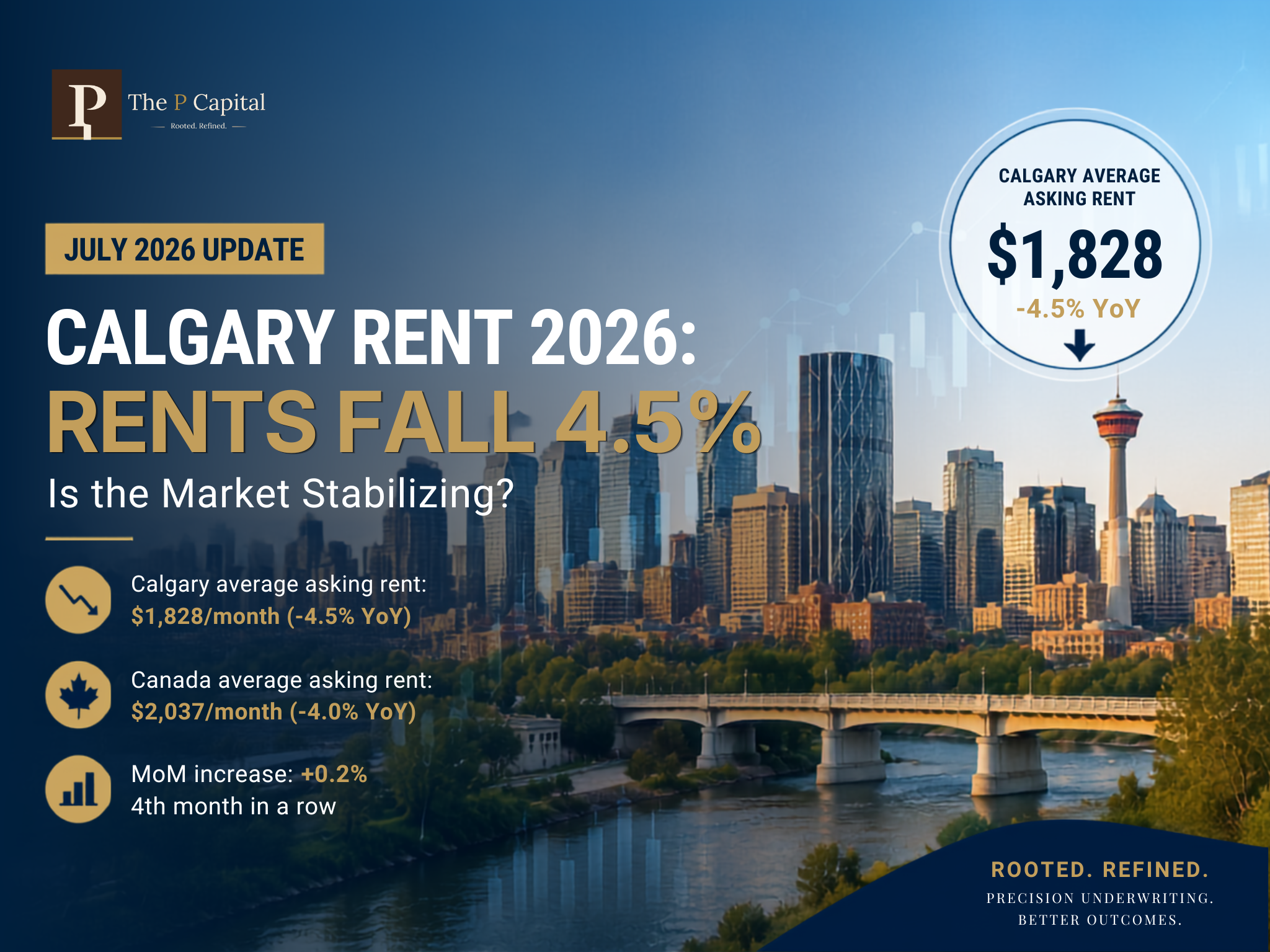
Calgary’s average asking rent fell 4.5% year-over-year in July 2026 to approximately $1,828 per month. But the bigger story is not simply that rents are falling — it is that the pace of decline appears to be slowing.
Across Canada, average asking rent was approximately $2,037/month, down 4.0% from July 2025. However, asking rents increased 0.2% month-over-month, marking the fourth consecutive monthly increase.
The takeaway?
Canada’s rental market appears to be stabilizing, but it is too early to call it a recovery.
What happened to Canadian rents in July 2026?
According to the latest Canadian rental-market data:
- Average asking rent in Canada: $2,037/month
- Year-over-year change: -4.0%
- Month-over-month change: +0.2%
- Calgary average asking rent: $1,828/month
- Calgary year-over-year change: -4.5%
July marked the 22nd consecutive month of year-over-year declines in Canadian asking rents.
At the same time, the monthly increase is worth watching.
A market can continue to show lower prices compared with last year while simultaneously beginning to stabilize from month to month.
That appears to be what the current data is showing.
What does this mean for Calgary?
Calgary’s rental market has been affected by a combination of new rental supply, changing migration patterns and evolving demand.
Recent multifamily data also showed Calgary’s apartment vacancy rate at 6.8% in Q2 2026, while the national apartment vacancy rate declined to 4.7%. This suggests rental conditions are becoming more balanced, although Calgary still has relatively more rental supply available than some other major Canadian markets.
For renters, that can mean more choice and less pressure than during the tightest period of the rental market.
For landlords and investors, however, it means rental assumptions need to be based on current market conditions rather than the rent growth seen several years ago.
Does falling rent mean you should keep renting?
Not necessarily.
A lower asking rent may make renting more attractive in the short term. But the rent-versus-buy decision depends on more than the monthly rent.
A prospective homebuyer should also consider:
- Purchase price
- Down payment
- Mortgage qualification
- Property taxes and insurance
- Condo fees and maintenance, where applicable
- Expected time in the property
- Overall household cash flow
This is particularly important for self-employed borrowers.
A business owner may have strong business cash flow but still face mortgage-qualification challenges because lenders assess income according to their own underwriting guidelines.
The question is not simply:
“How much money does the business make?”
It is also:
“What income can the lender reasonably recognize and support with the available documentation?”
Depending on the lender and the circumstances, certain add-backs or retained earnings may be considered. Treatment varies by lender guidelines and may require additional documentation or CPA confirmation.
What should Calgary buyers watch next?
Three indicators are particularly useful:
1. Rent trends
If monthly increases continue while the year-over-year decline becomes smaller, that would provide stronger evidence of stabilization.
2. Vacancy and supply
Calgary’s rental supply remains an important factor. A sustained decline in vacancy could eventually create upward pressure on rents.
3. The cost of ownership
For buyers, rental data should be considered alongside home prices, mortgage rates, property taxes and qualification requirements.
No single statistic can tell you whether buying or renting is the better decision.
The P perspective
Market data tells you what is happening.
Your financial structure determines what you can do about it.
That distinction matters when evaluating a mortgage — particularly for self-employed borrowers, whose income may require a more detailed review than a standard salaried application.
At The P Capital, we take an advisory-first approach to complex mortgage files.
We don't just submit files. We structure them.
If you're in Calgary and considering whether to continue renting, prepare to buy, or simply understand your mortgage options, looking at the numbers early can help you make a more informed decision.
Rooted. Refined.
Frequently Asked Questions
What is the average rent in Calgary in 2026?
Calgary’s average asking rent was approximately $1,828 per month in July 2026, down 4.5% compared with July 2025.
Are rents falling in Canada in 2026?
Yes. Canada’s average asking rent fell 4.0% year-over-year in July 2026. However, asking rents increased 0.2% month-over-month for the fourth consecutive month, suggesting the market may be stabilizing.
Is Calgary’s rental market recovering?
The latest data points more toward stabilization than recovery. Rents remain below last year’s levels, while monthly increases and changing vacancy conditions suggest the market may be finding a new balance.
Should I rent or buy in Calgary?
There is no universal answer. The decision depends on your purchase price, down payment, mortgage qualification, carrying costs and expected time horizon. Rental prices alone should not determine the decision.
Can self-employed Canadians qualify for a mortgage?
Yes, depending on the lender, business history, income documentation, debt obligations, credit profile and overall application. Self-employed income can require more detailed underwriting than conventional salaried income.
Sources: Canadian Mortgage Trends; Rentals.ca / Urbanation; Yardi Canadian Multifamily data, July 2026.
Market data refers to asking rents and may differ from rents paid by existing tenants. Market conditions and lending guidelines can change over time.
All client stories shared in The P Capital's content are composite illustrations inspired by real-world scenarios and created to protect client privacy. They do not represent any specific individual.
The P Capital is a boutique mortgage advisory practice based in Alberta, operating under Mortgage Connection and within the Dominion Lending Centres network.