Bank of Canada Holds Interest Rate at 2.25%: What It Means for Mortgage Borrowers in Canada
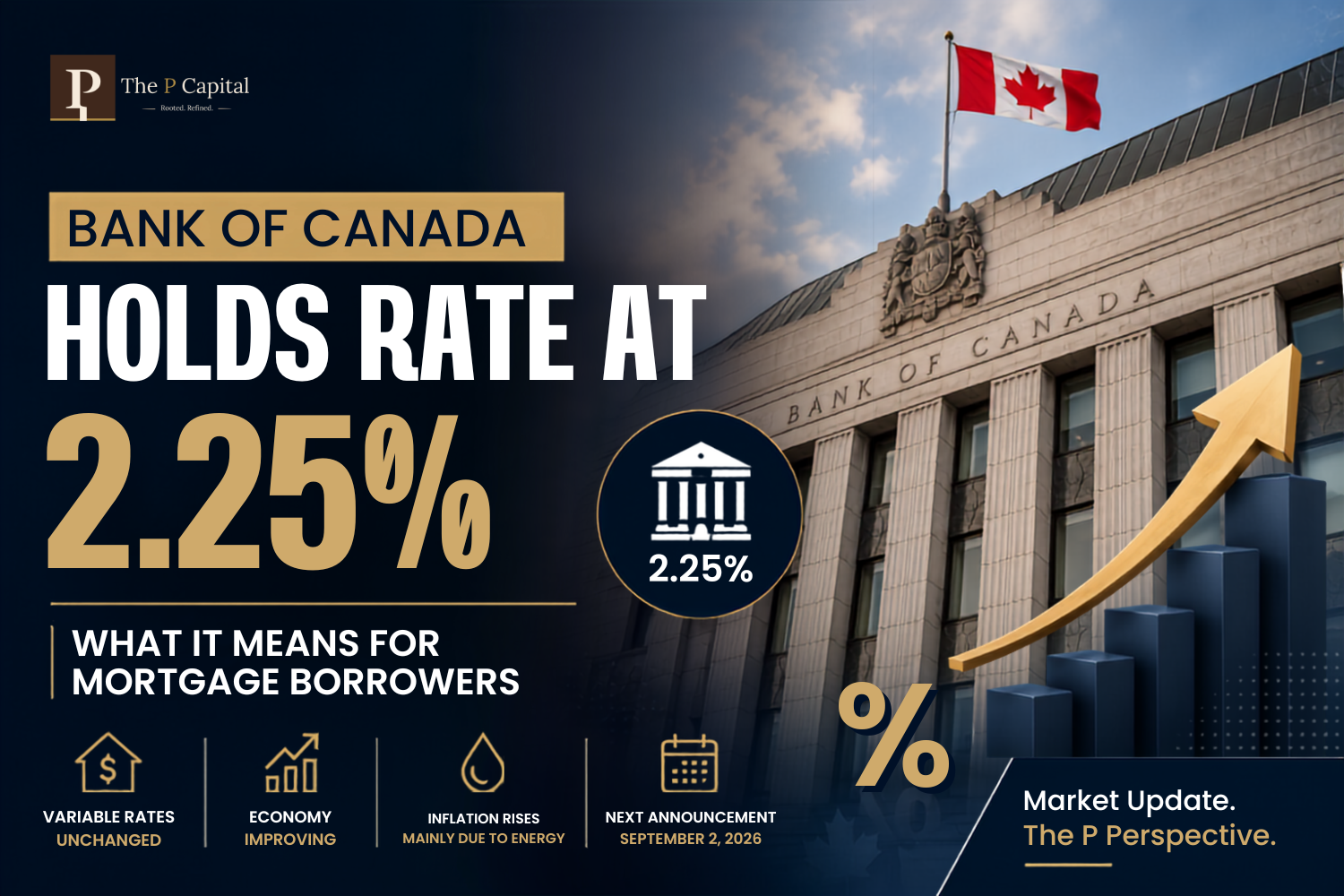
The Bank of Canada has announced that it will maintain its policy interest rate at 2.25%, keeping the Prime Rate at 4.45%.
For many Canadians, the immediate question is simple:
"Does this mean mortgage rates will stay the same?"
The answer is not necessarily.
While the Bank's decision directly affects variable-rate borrowing, fixed mortgage rates follow a different path. More importantly, a Bank of Canada announcement is only one piece of a much larger picture.
Whether you're buying your first home, renewing your mortgage, refinancing, or investing in real estate, understanding why the Bank held rates and how lenders respond can help you make better borrowing decisions.
Why Did the Bank of Canada Hold Rates?
The latest announcement reflects an economy moving in two different directions at the same time.
On one hand, Canada's economy is showing signs of recovery.
The Bank estimates that GDP grew at an annualized rate of 2.5% in the second quarter of 2026. Consumer spending remains resilient, exports have improved, housing activity appears to be stabilizing, and business investment is gradually recovering.
On the other hand, the economy has not fully regained its strength.
Canada's unemployment rate remains at 6.5%, indicating that excess capacity still exists across the labour market.
At the same time, headline inflation increased to 3.2%, largely because of rising gasoline prices linked to geopolitical disruptions in the Middle East.
However, there's an important distinction.
Inflation excluding gasoline was 2.2%, while core inflation remained close to the Bank's long-term target of 2%.
In other words, inflation has risen but much of that increase is still concentrated in energy rather than across the broader economy.
For policymakers, this creates a delicate balancing act.
Lowering interest rates too quickly could allow inflation to accelerate again.
Raising rates further could slow an economic recovery that is still gaining momentum.
Holding the policy rate allows the Bank of Canada to monitor whether today's higher energy prices become a temporary shock or evolve into broader inflation across the economy.
What Does This Mean for Mortgage Borrowers?
One of the biggest misconceptions after every Bank of Canada announcement is that all mortgage rates automatically move together.
They don't.
Different mortgage products respond to different market forces.
Variable-rate mortgages
Because the policy rate remains unchanged:
- Variable mortgage rates remain unchanged.
- HELOC rates remain unchanged.
- Personal lines of credit linked to Prime remain unchanged.
- Canada's Prime Rate stays at 4.45%.
Borrowers with existing variable-rate mortgages should not expect immediate payment changes as a result of this announcement.
Fixed-rate mortgages
Fixed mortgage rates work differently.
Rather than following the Bank of Canada's overnight rate directly, they are influenced primarily by:
- Government of Canada bond yields
- Lenders' cost of funds
- Competitive pricing among lenders
- Overall market expectations
This explains why fixed mortgage rates sometimes move before the Bank of Canada changes its policy rate or even move in the opposite direction.
Understanding this distinction is one of the most important pieces of mortgage education for borrowers.
Why This Matters More Than Many People Realize
Every rate announcement generates headlines predicting whether mortgage rates will rise or fall.
In reality, borrowers often place too much attention on trying to predict the Bank of Canada's next move.
While interest rates certainly matter, they are only one factor that determines the overall cost and suitability of a mortgage.
Questions such as:
- Which lender best fits your income profile?
- How will your income be assessed?
- Are you purchasing, refinancing, or renewing?
- Is your income salaried, commissioned, or self-employed?
- Do you need flexibility for future financial plans?
can often have a greater impact on your borrowing outcome than a small change in interest rates alone.
A mortgage with a slightly lower advertised rate may not be the best solution if its qualification guidelines don't match your financial situation.
The Difference Between a Bank Decision and a Lender Decision
One perspective we frequently share with clients is that there are two different conversations happening in the mortgage market.
The first is the Bank of Canada's monetary policy decision. The second is the lender's pricing decision. The two are connected but they are not the same. The Bank of Canada sets the direction for overnight borrowing costs. Lenders then determine how to price their mortgage products based on funding costs, bond markets, competition, portfolio strategy, and risk appetite.
That is why two lenders can offer different mortgage rates on the same day—even though the Bank of Canada's policy rate hasn't changed.
Understanding this difference helps borrowers move beyond chasing the lowest advertised rate and start evaluating the mortgage solution as a whole.
What Borrowers Should Watch Next
Although the policy rate remained unchanged, several economic indicators will continue influencing future mortgage pricing:
- Oil and gasoline prices
- Inflation beyond the energy sector
- Government bond yields
- Labour market conditions
- Business investment
- Canada–U.S. trade developments
- Consumer spending and economic growth
These indicators will shape both future Bank of Canada decisions and how lenders adjust mortgage pricing in the months ahead.
The P Perspective
At The P Capital, we believe mortgage advice should go beyond interpreting interest rate announcements.
Our role is to help clients understand how economic conditions translate into real borrowing decisions.
Every lender has its own underwriting philosophy, documentation requirements, and income assessment guidelines.
For many borrowers - particularly self-employed business owners, incorporated professionals, investors, or those with multiple income sources—the choice of lender can be just as important as the interest rate itself.
Rather than starting with the question,"Who has the lowest rate today?" we begin with a different question:"Which lender is most likely to understand your financial story?"
Once that foundation is established, we identify the most competitive mortgage solution available within that lender's guidelines.
Because successful mortgage planning isn't about predicting every interest rate announcement.
It's about structuring the right strategy before an application is ever submitted.
Final Thoughts
The Bank of Canada's decision to hold its policy rate at 2.25% reflects an economy that is recovering gradually while policymakers continue monitoring inflation risks.
For borrowers, the key takeaway is straightforward:
- Variable-rate mortgages remain stable for now.
- Fixed mortgage rates will continue responding primarily to bond markets and lender pricing decisions.
- The lowest advertised rate isn't always the best mortgage solution.
As the market continues to evolve, preparation and informed decision-making remain far more valuable than trying to perfectly time the next interest rate announcement.
If you're planning to purchase a home, refinance, renew your mortgage, or simply want to understand how today's market affects your borrowing options, having the right lending strategy can make a meaningful difference.
Rooted. Refined.
Disclaimer: This article is provided for general educational purposes only and should not be considered financial, investment, or legal advice. Interest rates, mortgage products, and lender guidelines are subject to change without notice. Please consult a qualified mortgage professional regarding your individual circumstances.
The P Capital is a boutique mortgage advisory practice based in Alberta, operating under Mortgage Connection and within the Dominion Lending Centres network.